Did you know it can take up to 400 repetitions for a child to master a new skill? But when kids learn through play, the process becomes much quicker. In fact, studies show that play can help kids learn faster and with more joy. Play isn’t just for fun—it’s a powerful tool for childhood development and learning.
The Science Behind Play and Learning
When a child learns something new, their brain creates connections between neurons, called synapses. These synapses form the brain’s communication network, allowing information to pass from one part of the brain to another. However, building these synapses takes effort and time. Traditional learning methods often require hundreds of repetitions to form a new synapse in the brain.
Dr. Karyn Purvis, a developmental psychologist, discovered something remarkable: while it typically takes around 400 repetitions to create a new synapse, doing so through play only requires about 20 repetitions. The reason for this lies in how our brains respond to play. Play activates multiple areas of the brain at once, engaging emotions, motor skills, and cognitive processes. It also releases positive chemicals, like dopamine, which enhance memory and attention.
In essence, the brain learns best when it’s having fun. Play-based activities stimulate brain growth and help kids learn faster by creating stronger and more efficient neural pathways. This research underscores the importance of play not just as a break from learning, but as one of the most effective ways to foster brain development.
Learning Through Play vs. Repetition

Now, let’s bring this research into a real-life scenario. Imagine your child is learning to spell basic words like “cat,” “dog,” and “hat.” You could ask them to write these words over and over on a piece of paper. After hours of repetition, they might begin to recognize the words, but the process is slow, and it can feel tedious for both you and your child.
Contrast this with a playful approach. Let’s say you create a game where your child acts out the words, pretending to be the animals they’re spelling. As they crawl like a cat, bark like a dog, or flap their arms like a bird wearing a hat, they’re naturally incorporating movement, creativity, and laughter. In this scenario, learning is much faster and more enjoyable because their brains are fully engaged in a multi-sensory experience.
By transforming repetitive tasks into playful activities, children not only absorb information quicker but also retain it longer. Play not only helps kids learn faster but makes the entire process something they look forward to.
Practical Ways to Incorporate Play-Based Learning at Home
Now that we understand how play can help kids learn faster, let’s explore some practical ways to incorporate play-based learning into your daily routine. Here are ten easy ideas:
- Math scavenger hunt: Hide numbers or math problems around the house and have your child solve them to find their next clue.
- Alphabet hop: Write letters on the ground with chalk and have your child hop from letter to letter as they practice spelling words.
- Role-playing for reading comprehension: Act out stories with your child to help them better understand plot, characters, and themes.
- DIY grocery store: Use pretend money and set up a mini-store where your child can “buy” groceries, learning math and decision-making.
- Shape sorting with toys: Have your child sort their toys by shape, color, or size, turning cleanup time into a learning opportunity.
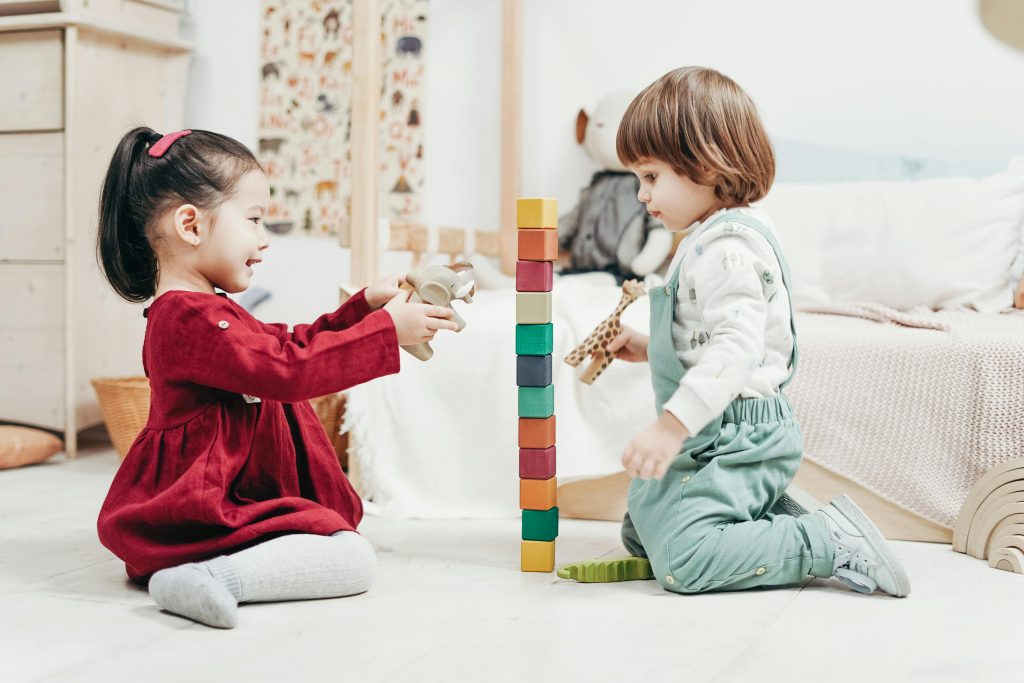
- Building blocks for problem-solving: Challenge your child to build the tallest tower or a specific structure using blocks, encouraging creativity and spatial reasoning.
- Counting during physical activities: Incorporate counting into activities like jumping rope or bouncing a ball to combine movement and learning.
- Create art for storytelling: Let your child draw or paint scenes from a story they’ve read to help with memory recall and comprehension.
- Puzzles for pattern recognition: Use puzzles to teach shapes, patterns, and problem-solving skills in a fun and engaging way.
- Music for memory: Create songs or rhymes about what your child is learning—whether it’s math facts, the alphabet, or historical events.
These activities can seamlessly blend play with learning, making education an enjoyable and memorable experience for your child. By incorporating play into everyday moments, you’ll not only help your kids learn faster, but you’ll foster a lifelong love of learning.
Wanna kick things up a notch? Move the play/learning OUTSIDE! Check out this other article on the importance of outdoor time for your kids.
